
Understand your network. Prove your compliance.
TIENOOC tests every router, switch, firewall, load balancer, wireless controller and proxy automatically against your own standard and against frameworks such as NIS2 and IEC 62443. You see at once what deviates, what the risk is and how to fix it, and the evidence for the audit is ready.
Less handwork. Less risk. More control.
Tests against NIS2 · IEC 62443 · ISO/IEC 27001 · NIST SP 800-82/53 · NERC CIP · PCI DSS, with the clause each finding touches.
Higher quality, higher productivity
TIENOOC and KIDJO·AI⁶ raise the quality and the productivity of your data network considerably: fewer errors, less handwork, and a team that spends its time improving instead of searching.
Where TIENOOC makes the difference
Many organisations do not know exactly which configurations deviate from the standard, which firewall rules are a risk, whether segmentation is really followed, or whether they are ready for the audit. TIENOOC brings that into view and delivers the evidence.
Configuration that drifts from the standard
Naming, VLANs, the IP plan and the baseline apply to the whole estate; a quick fix and a temporary rule later, they no longer match. TIENOOC measures every device against your standard, whenever you want, and lays your baseline itself next to the vendor's best practice.
You see per device what deviates, with the fix configuration next to it.
Thousands of firewall and proxy rules
Rules, objects and service groups, spread over many sheets. TIENOOC analyses the whole set against your baseline: any-to-any, rules that are too broad, shadowed, duplicate or disabled, missing logging, and names outside the convention.
You get a proposal for improvement: which rules, what to change, and why.
The periodic report
Every quarter or half year you show that the policies on your security systems still conform to the standard. TIENOOC runs that test at the moment you set and delivers the report in PDF or Word, each finding tied to the clause of the standards you choose.
The evidence is ready on the date, including what changed since the previous report.
A CMDB and IPAM that are right
TIENOOC validates the content of your registers. The CMDB against what is there: does the hardware exist, is it online, does it sit at the recorded location. The IPAM against the site and VLAN registers and the IP plan, subnet by subnet.
You know which records you can rely on and which to correct.
What TIENOOC delivers
- Direct insight into deviations
- Evidence for the audit, at any moment
- Faster preparation for NIS2 and IEC 62443
- Fewer manual checks
- Control over complex networks
- Decisions based on facts
The fix with every finding
Every finding names the device, the line and the check it failed, with the configuration that solves it.
Change in view
Every run sits next to the previous run of the same system: new, solved, worse, better. The dashboard shows the estate the same way.
Accepted risks on record
What you accept moves to the exception register, with who and when, and stays out of the next list of findings.
Within your own domain
TIENOOC is an appliance on your own network. It runs air-gapped, under your supervision.
What it looks like
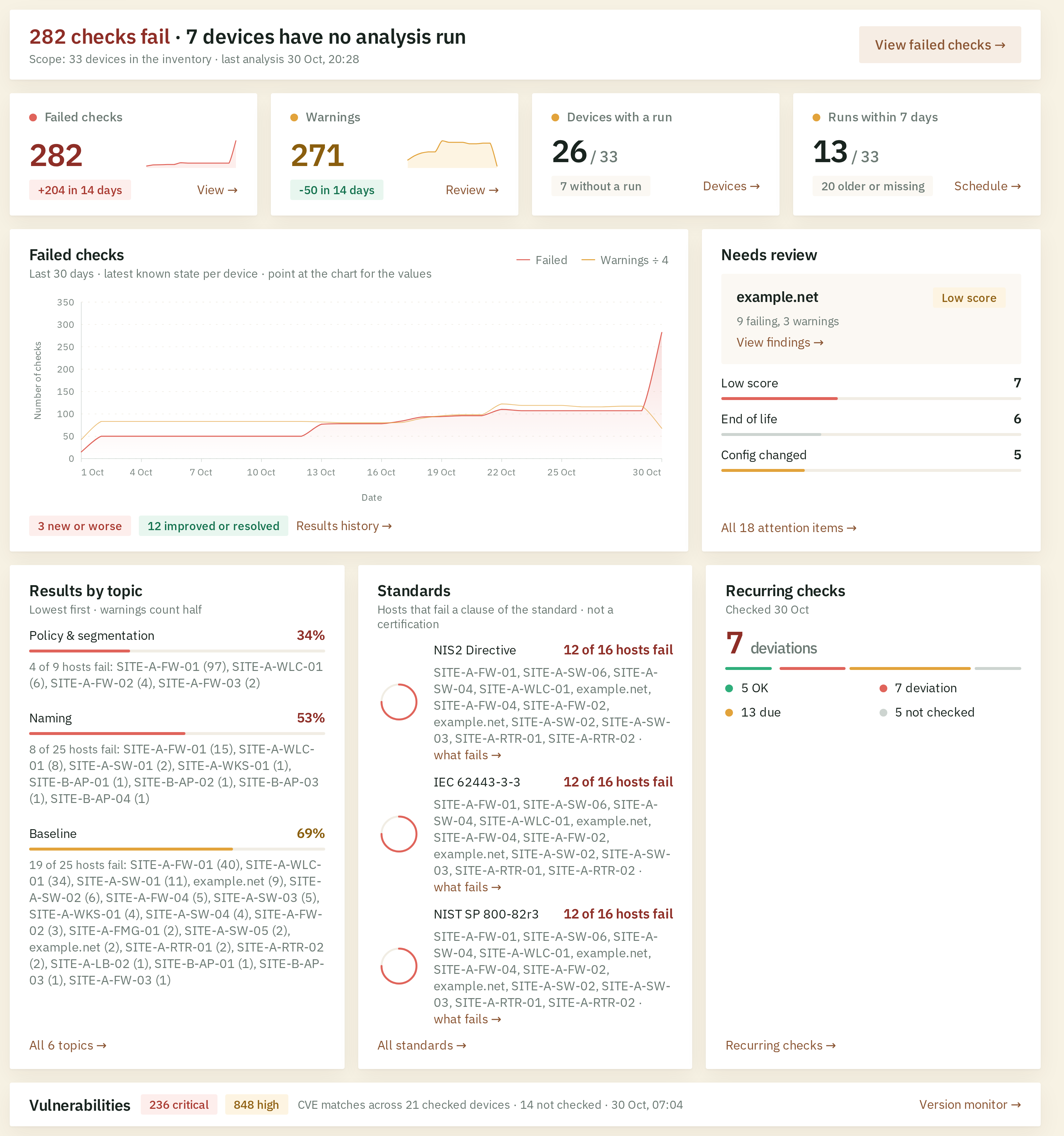
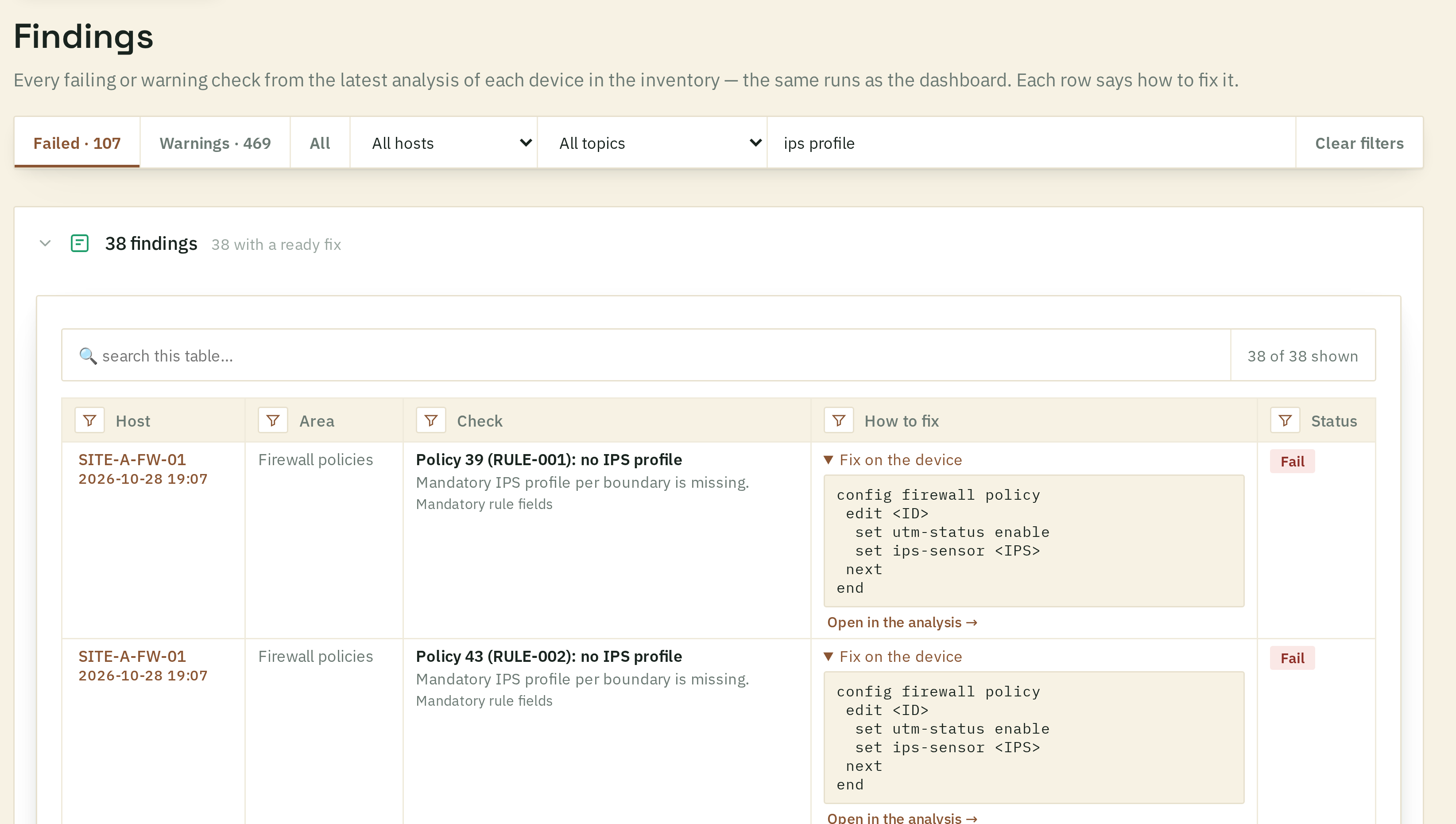
Real screens; names and addresses have been made unrecognisable. Click a screen to enlarge it.
What it reads
Every kind of network system, whatever the brand.
| Kind of system | What is tested |
|---|---|
| Firewalls | Management access, crypto, logging, NTP, SNMP, policies, zones, objects, access lists |
| Switches | Hardening, AAA, SNMP, NTP, logging, VLANs, interface hardening, naming |
| Routers | Hardening, AAA, SNMP, NTP, logging, VRFs and leaks, routing, naming |
| Load balancers | Management access, logging, NTP, virtual servers and their rules |
| Wireless controllers | Controller hardening and WLAN security |
| Proxies and cloud security | Filtering rules and their order |
| CMDB and IPAM | The records against reality and against the company standard: hardware, location, name, model, subnets |
| Your design | The design workbook next to the firewall built from it: what is missing, what is extra, what differs |
The standards you test against
Per analysis you choose which standards take part. Every finding then names the clause it touches.
- NIS2
- IEC 62443-3-3
- ISO/IEC 27001:2022
- DORA
- NIST SP 800-82r3
- PCI DSS v4.0.1
See all standards, per region
| Region | Standards |
|---|---|
| International | IEC 62443-3-3 · ISO/IEC 27001:2022 · PCI DSS v4.0.1 |
| Europe | NIS2 · EU 2024/2690 · DORA RTS 2024/1774 |
| United Kingdom | Cyber Essentials v3.2 |
| North America | NIST SP 800-82r3 · NIST SP 800-53 Rev. 5 · NERC CIP · CISA CPG 2.0 |
| Saudi Arabia | OTCC-1:2022 · ECC-2:2024 and ECC-1:2018 |
| United Arab Emirates | UAE IA Regulation v1.1 |
| Qatar | NIA Standard V2.1 |
| South Africa | Joint Standard 2 of 2024 (FSCA / Prudential Authority) |
| Morocco | DNSSI 2023 |
| Rwanda | NCSA Minimum Cybersecurity Standards (2023) |
| China | GB/T 22239-2019 (MLPS 2.0) · GB/T 39786-2021 |
| India | CEA Cyber Security Regulations 2026 |
| Singapore | CCoP 2026 (Cybersecurity Code of Practice for CII) |
| Australia | ISM 2026.09 · Essential Eight · AESCSF v2 |
| Brazil | ONS RO-CB.BR.01 Rev.00 |
| Argentina | DA 641/2021 |
KIDJO·AI6 in TIENOOC
Ask your network directly, in plain language. The answers come from your own configurations, analyses and reports: no internet data, no generic AI answers.
- "Why does this site not meet IEC 62443?"
- "Which firewall rules deviate from the standard?"
- "Which switches deviate from the baseline?"
- "What has changed since last month?"
Answers from your own data
The assistant in the corner of every TIENOOC page. Ask in your own words which firewalls drifted since last week or why a check fails; it looks it up, explains it and takes you to the screen where you solve it. Runs on your own network.
Does the work
Say: make a report of all firewalls. It runs the analysis, builds the PDF and sends it to your mail. The same for a summary since last week or the delta of one device.
See TIENOOC at work
A demonstration
We show TIENOOC on a running network and answer your questions. Ask for a demonstration.
A quote
Tell us which systems you have; that decides what you need. Ask for a quote.